ARIMA
Los modelos ARIMA describen fenómenos que evolucionan a lo largo del tiempo y predicen valores futuros. ARIMA significa AutoRegressive Integrated Moving Average (en español Media Móvil Integrada Autorregresiva). Ejecútelos en Excel utilizando el software estadístico complementario XLSTAT.
XLSTAT ofrece una amplia selección de modelos ARIMA como ARMA (Media Móvil Autorregresiva), ARIMA (Media Móvil Integrada Autorregresiva) o SARIMA (Media Móvil Integrada Estacional). De este modo, puede ejecutar fácilmente un ARIMA para la previsión de series temporales sin necesidad de python o R. Estos modelos pueden utilizarse en el aprendizaje automático aplicado en diversos campos como las finanzas, para predecir la evolución del precio de las acciones, pero también en meteorología para predecir las temperaturas.
¿Cómo funciona ARIMA?
Los modelos de la familia ARIMA permiten representar de forma sintética fenómenos que varían con el tiempo y predecir valores futuros con un intervalo de confianza en torno a las predicciones. Están adaptados específicamente a los datos de series temporales, más que un modelo clásico de regresión lineal.
La redacción matemática de los modelos ARIMA difiere de un autor a otro. Las diferencias se refieren la mayoría de las veces al signo de los coeficientes. XLSTAT utiliza la escritura más común, utilizada por la mayoría de los programas informáticos. Si definimos por Xt una serie con media µ, entonces si se supone que la serie sigue un modelo ARIMA(p,d,q)(P,D,Q)s, podemos escribir
[ Yt = (1 – B)d (1 – Bs)D Xt - µ ; Φ(B)Ø(Bs))Yt = θ(B) Θ(Bs) Zt, Zt∞N(0,σ2) ]
con
[ Φ(z) = 1 – Σpi=1 Φi zi, Ø(z)= 1 – Σpi=1 Øi zi ; θ(z) = 1 + Σqi=1 θi zi, Θ(z) = 1 + Σqi=1 Θi zi ]
p es el orden de la parte autorregresiva del modelo. q es el orden de la parte de media móvil del modelo. d es el orden de diferenciación del modelo. D es el orden de diferenciación de la parte estacional del modelo. s es el periodo del modelo (por ejemplo, 12 si los datos son mensuales, y si se observa una periodicidad anual en los datos). P es el orden de la parte estacional autorregresiva del modelo. Q es el orden de la parte estacional de media móvil del modelo.
- Observación 1: el proceso Yt es causal si y solo si para cualquier z tal que |z|≤1, f(z)≠0 y q(z)≠0.
- Observación 2: si D=0, el modelo es un modelo ARIMA(p,d,q). En ese caso, P, Q y s se consideran nulos.
- Observación 3: si d=0 y D=0, el modelo se simplifica a un modelo ARMA(p,q). En este caso, podemos afirmar que la serie es estacionaria.
- Observación 4: si d=0, D=0 y q=0, el modelo se simplifica a un modelo AR(p).
- Observación 5: si d=0, D=0 y p=0, el modelo se simplifica a un modelo MA(q).
Variables explicativas
XLSTAT permite tener en cuenta las variables explicativas a través de un modelo lineal. Son posibles tres enfoques diferentes:
- OLS: Se ajusta un modelo de regresión lineal utilizando el método clásico de regresión lineal, luego los residuos se modelan utilizando un modelo (S)ARIMA.
- CO-LS: Si d o D y s no son cero, los datos (incluidas las variables explicativas) se diferencian, y luego se ajusta el modelo ARMA correspondiente al mismo tiempo que los coeficientes del modelo lineal utilizando el enfoque de Cochrane y Orcutt (1949).
- GLS: Se ajusta un modelo de regresión lineal, luego los residuos se modelan utilizando un modelo (S)ARIMA, luego volvemos al paso de regresión, para mejorar la probabilidad del modelo cambiando los coeficientes de regresión utilizando el algoritmo de Newton-Raphson.
- Nota: si no se solicita la diferenciación (d=0 y D=0), y si no hay variables explicativas en el modelo, la constante del modelo se estima utilizando CO-LS.
Resultados del análisis ARIMA en XLSTAT
Veamos cómo interpretar los resultados del modelo ARIMA.
Estadística de resumen: Esta tabla muestra para las variables seleccionadas, el número de observaciones, el número de valores perdidos, el número de valores no perdidos, la media y la desviación estándar (insesgada).
Si se ha solicitado una estimación preliminar y una optimización, se muestran primero los resultados de la estimación preliminar y después los resultados de la optimización. Si se han introducido coeficientes iniciales, se muestran primero los resultados correspondientes a estos coeficientes.
Coeficientes de bondad de ajuste:
- Observaciones: El número de datos utilizados para el ajuste del modelo.
- SSE: Suma de cuadrados de los errores. Este estadístico se minimiza si se ha seleccionado la opción "Mínimos Cuadrados" para la optimización.
- MAPE: El Error Medio Absoluto Porcentual mide la calidad del ajuste, eliminando el efecto de escala y no penalizando relativamente los errores más grandes.
- Varianza del ruido blanco: La varianza del ruido blanco es igual al SSE dividido por N. En algunos programas informáticos, esta estadística se denomina sigma2 (sigma-cuadrado).
- Estimación de la varianza del ruido blanco**: Este estadístico suele ser igual al anterior. En el caso de una estimación preliminar mediante los algoritmos de Yule-Walker o Burg, se muestra una estimación ligeramente diferente.
- 2Log(Like.): Este estadístico se minimiza si se ha seleccionado la opción "Probabilidad" para la optimización. Es igual a 2 veces el logaritmo natural de la probabilidad.
- FPE: Error de predicción final de Akaike. Este criterio está adaptado a los modelos autorregresivos.
- AIC: El criterio de información de Akaike.
- AICC: Este criterio ha sido sugerido por Brockwell (Akaike Information Criterion Corrected).
- SBC: Criterio Bayesiano de Schwarz.
Parámetros del modelo:
La primera tabla de parámetros da los coeficientes del modelo lineal ajustado a los datos (una constante si no se ha seleccionado ninguna variable explicativa).
La siguiente tabla da el estimador de cada coeficiente de cada polinomio, así como la desviación estándar obtenida directamente del método de estimación (estimación preliminar), o de la matriz de información de Fisher (hessiana). También se calculan las desviaciones estándar asintóticas. Para cada coeficiente y cada desviación estándar, se muestra un intervalo de confianza. Los coeficientes se identifican como sigue:
- AR(i): que corresponde al coeficiente de orden i del polinomio f(z).
- SAR(i): coeficiente que corresponde al coeficiente de orden i del polinomio F(z).
- MA(i): coeficiente que corresponde al coeficiente de orden i del polinomio q(z).
- SMA(i): coeficiente que corresponde al coeficiente de orden i del polinomio Q(z).
Datos, Predicciones y Residuales: Esta tabla muestra los datos, las correspondientes predicciones calculadas con el modelo arima y los residuos. Si el usuario lo solicita, se calculan las predicciones para los datos de validación y las previsiones para los valores futuros. Las desviaciones estándar y los intervalos de confianza se calculan para las predicciones de validación y las previsiones.
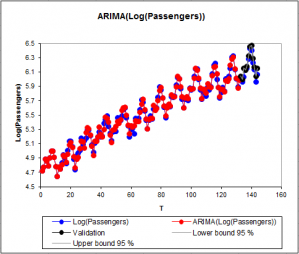
Gráficos: Se muestran dos gráficos. El primer gráfico muestra los datos, los valores correspondientes predichos por el modelo y las predicciones correspondientes a los valores para los pasos de tiempo de validación y/o predicción. El segundo gráfico corresponde al gráfico de barras de los residuos.
Ejemplo
En el sitio web de Addinsoft hay un tutorial que explica cómo ajustar un modelo ARIMA y utilizar el modelo para hacer predicciones.


analice sus datos con xlstat
Incluido en
Productos relacionados