Univariate plots

Univariate plots is part of:
  • Pro Core statistical software

  • System configuration

    • Windows:
      • Versions: 9x/Me/NT/2000/XP/Vista/Win 7
      • Excel: 97 and later
      • Processor: 32 or 64 bits
      • Hard disk: 150 Mb
    • Mac OS X:
      • OS: OS X
      • Excel: X, 2004 and 2011
      • Hard disk: 150Mb.

Benefits

  • Easy and user-friendly
    Easy and user-friendly XLSTAT is flawlessly integrated with Microsoft Excel which is the most popular spreadsheet worldwide. This integration makes it one of the simplest available tools to work with as it utilizes the same philosophy as Microsoft Excel. The program is accessible in a dedicated XLSTAT tab. The analyses are grouped into functional menus. The dialog boxes are user-friendly and setting up an analysis is straightforward.
  • Data and results shared seamlessly
    Data and results shared seamlessly One of the greatest advantages of XLSTAT is the way you can share data and results seamlessly. As the results are stored in Microsoft Excel, anyone can access them. There is no need for the receiver to have an XLSTAT license or any additional viewer which makes your team-work easier and more affordable. In addition, results are easily integrable into other Microsoft Office software such as PowerPoint, so that you can create striking presentation in minutes.
  • Modular
    Modular XLSTAT is a modular product. XLSTAT-Pro is a core statistical module of XLSTAT which includes all the mainstream functionalities in statistics and multivariate analysis. More advanced features contained in add-on modules can be added for specific applications. This way you can adapt the software to your needs making the software more cost-efficient.
  • Didactic
    Didactic The results of XLSTAT are organized by analysis and are easy to navigate. Moreover useful information is provided along with the results to assist you in your interpretation.
  • Affordable
    Affordable XLSTAT is a complete and modular analytical solution that can suit any analytical business needs. It is very reasonably priced so that the return of your investment is almost immediate. Any XLSTAT license comes with top level support and assistance.
  • Accessible - Available in many languages
    Accessible - Available in many languages We have ensured XLSTAT is accessible to everyone by making the program available in many languages, including Chinese, English, French, German, Italian, Japanese, Polish, Portuguese and Spanish.
  • Automatable and customizable
    Automatable and customizable Most of the statistical functions available in XLSTAT can be called directly from the Visual Basic window of Microsoft Excel. They can be modified and integrated to more code to fit to the specificity of your domain. Adding tables and plots as well as modifying existing outputs becomes easy. Furthermore, XLSTAT includes some special tools on the dialog boxes to generate automatically the VBA code in order to reproduce your analysis using the VBA editor or to simply load pre-set settings. This effortless automation of routine analysis will be a huge time saver on your part.

Before using advanced analysis methods you must first of all reveal the data in order to identify trends, locate anomalies or simply have available essential information such as the minimum, maximum or mean of a data sample.

XLSTAT offers you a large number of descriptive statistics and charts which give you a useful and relevant preview of your data.

Although you can select several variables (or samples) at the same time, XLSTAT calculates all the descriptive statistics for each of the samples independently. Several types of chart are available.

Charts for quantitative data

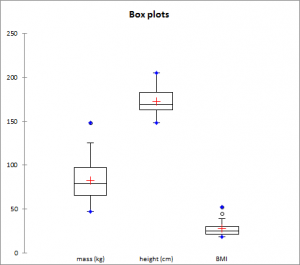
Box plot

Also called "box and whisker diagram". It is a simple and quite complete representation since in the version provided by XLSTAT the minimum, 1st quartile, median, mean and 3rd quartile are displayed together with both the limits (the ends of the "whiskers") beyond which values are considered anomalous.

Scattergram

It gives an idea of the distribution and possible plurality of the modes of a sample. All points are represented together with the mean and the median.

Strip plot

It represents the data from the sample as strips. For a given interval, the thicker or more tightly packed the strips, the more data there is.

P-P Chart (Normal distribution)

P-P chart (for Probability-Probability) is used to compare the empirical distribution function of a sample with that of a normal variable for the same mean and deviation. If the sample follows a normal distribution, the data will lie along the first bisector of the plan.

Q-Q Chart (Normal distribution)

Q-Q chart (for Quantile-Quantile) is used to compare the quantities of the sample with that of a normal variable for the same mean and deviation. If the sample follows a normal distribution, the data will lie along the first bisector of the plan.

Charts for qualitative data

Bar chart

It represents the frequencies or relative frequencies of the various categories of qualitative variables as bars.

Pie chart

It represents the frequencies or relative frequencies of the various categories of qualitative variables as pie charts.

Double pie chart, Doughnut, Stacked bars and Multiple bars

Those plots are used to compares the frequencies or relative frequencies of sub-samples with those of the complete sample.

Screenshots