DOE for sensory data analysis
Design of Experiments for Sensory data analysis is used to maximize the usability of data collected. Available in Excel using the XLSTAT statistical software.
Why do we use Design of Experiment in Sensory data analysis
Designing an experiment is a fundamental step for anyone who wants to ensure that data collected will be statistically usable in the best possible way. No use to evaluate products from a panel of judges if the products cannot be compared under statistically reliable conditions. It is also not necessary to have each judge evaluate all products to compare products between them.
This tool is designed to provide specialists in sensory analysis a simple and powerful tool to prepare a sensory evaluation where judges (experts and/or consumers) evaluate a set of products.
What does XLSTAT Design of Experiment in Sensory data analysis tools take into account
When you want a panel of consumers to evaluate a set of products, the first issue that arises is what is the appropriate number of consumers that should be involved, knowing that there may be technical constraints (a limited number of trained consumers is available), or budgetary constraints.
Once the number of consumer is defined, the question of the maximum number of products that a consumer can evaluate during each session arises.
It remains to determine which products will be evaluated by each of the consumers in each session, and in what order. It is possible that the order has an influence. To avoid penalizing certain products we should ensure that products are seen as often as possible in the three different positions during each session. Furthermore, it is possible that some sequences of products also have a bearing on sensory assessments. We restrict here to consider pairs of products (carry-over of order 2). As for the order, we will also ensure that different ordered pairs, be present at a frequency as homogeneous as possible in the design.
When generating the plan we therefore try to reconcile the following three requirements:
- Products must be seen by as many judges as possible and with an overall frequency of the different products as homogeneous as possible,
- Each product must be seen in the different orders during each session, with an overall frequency for each pair (order, product) as homogeneous as possible
- The different ordered pairs of products must be present in the design of experiments with a frequency as homogeneous as possible.
XLSTAT Design of Experiment in Sensory data analysis quality criteria
XLSTAT allows users to search an optimal design within the meaning of the A-efficiency or the D-efficiency, and whether in the case of complete plans or in the case of incomplete block designs, whether balanced or not.
Order of the product
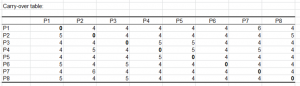
Once the design is found (the matrix N is known), we need to order products to optimize the in terms of column frequency and carry-over (Périnel and Pagès, 2004). We want that each product is present the same number of times at a given position, and that each ordered pair is also present the same number of times. In order to obtain that, XLSTAT uses two matrices: the matrix of column frequencies and the matrix of carry-over.
XLSTAT algorithm for Design of Experiment in Sensory data analysis
The optimization algorithm is iterative. It is sometimes necessary to split sensory evaluations into sessions. To generate a design that takes into account the need for sessions, XLSTAT uses the same intial design for each session and then applies permutations to both rows and columns, while trying to keep as even as possible column frequencies and carry-over. When the designs are resolvable or near resolvable, the same judge will not be testing twice the same product during two different sessions.


analyze your data with xlstat
Related features