DoE for choice based conjoint (CBC) analysis
Design of experiments is crucial step in Choice Based Conjoint analysis. Design your CBC questionnaires in Excel using the XLSTAT statistical software.
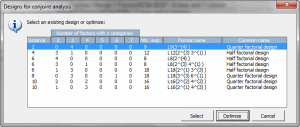
Principle of design of experiments for choice based conjoint (CBC) analysis
The principle of conjoint analysis is to present a set of products (also known as profiles) to the individuals who will note, class, or choose some of them.
In an ideal analysis, individuals should test all possible products. But it is soon impossible; the capacity of each being limited and the number of combinations increases very rapidly with the number of attributes (if one wants to study five attributes with three categories each, that means already 243 possible products). We therefore use the methods of experimental design to obtain a acceptable number of profiles to be judged while maintaining good statistical properties.
XLSTAT-Conjoint analysis software includes two different methods of conjoint analysis: the full profiles analysis and the choice based conjoint (CBC) analysis.
Design of Experiment for Choice Based Conjoint analysis (CBC)
The principle of choice based conjoint (CBC) analysis is based on choices in a group of profiles. The individual respondent chooses between different products offered instead of rating or ranking products.
The process of CBC is based on comparisons of profiles. These profiles are generated using the same methods as for full profile conjoint analysis. Then, these profiles are put together in many comparison groups (with a fixed size). The individual respondent then chooses the profile that he would select compared to the other profiles included in the comparison.
The statistical process is separated into 2 steps:
- Fractional factorial designs or D-optimal designs are used to generate the profiles.
- Once the profiles have been generated they are allocated in the comparison groups using incomplete block designs.
Selecting the factor for choice based conjoint analysis
The first step in a conjoint analysis requires the selection of a number of factors describing a product. These factors should be qualitative. For example, if one seeks to introduce a new product in a market, we can choose as differentiating factors: the price, the quality, the durability ... and for each factor, we must define a number of categories (different prices, different lifetimes ...). This first step is crucial and should be done together with experts of the studied market.
Generating the design of experiments for the choice based conjoint analysis
Once past this first step, the goal of a conjoint analysis is to understand the mechanism for choosing one product over another. Instead of proposing all profiles to the individual respondents and asking to rate or rank them, CBC is based on a choice after a comparison of some of the profiles. Groups of profiles are presented to the individual respondents and they have to indicate which profile they would choose (a no choice option is also available in XLSTAT-Conjoint).
This method combines two designs of experiments, the fractional factorial design to select the profiles to be compared and the incomplete block design to generate the comparisons to be presented.
XLSTAT-Conjoint enables you to add the no choice option if the individual respondent would not choose any of the proposed profiles.
XLSTAT-Conjoint analysis software provides you with a global table for CBC analysis but also individual tables for each respondent and each comparison in separated Excel sheets. References are also included so that when a respondent select a profile in an individual sheet, it is directly reported in the main table.
Prohibited combinations option
For some experimental designs, categories combinations are not feasible. This may be due to different reasons: equipment, products, ... In these cases, it is possible to indicate these prohibited combinations, the generated experimental design will not take them into account.

