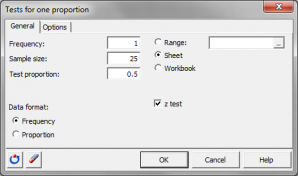
Comparison of one proportion

Comparison of one proportion is part of:
  • Pro Core statistical software

  • System configuration

    • Windows:
      • Versions: 9x/Me/NT/2000/XP/Vista/Win 7
      • Excel: 97 and later
      • Processor: 32 or 64 bits
      • Hard disk: 150 Mb
    • Mac OS X:
      • OS: OS X
      • Excel: X, 2004 and 2011
      • Hard disk: 150Mb.

Benefits

  • Easy and user-friendly
    Easy and user-friendly XLSTAT is flawlessly integrated with Microsoft Excel which is the most popular spreadsheet worldwide. This integration makes it one of the simplest available tools to work with as it utilizes the same philosophy as Microsoft Excel. The program is accessible in a dedicated XLSTAT tab. The analyses are grouped into functional menus. The dialog boxes are user-friendly and setting up an analysis is straightforward.
  • Data and results shared seamlessly
    Data and results shared seamlessly One of the greatest advantages of XLSTAT is the way you can share data and results seamlessly. As the results are stored in Microsoft Excel, anyone can access them. There is no need for the receiver to have an XLSTAT license or any additional viewer which makes your team-work easier and more affordable. In addition, results are easily integrable into other Microsoft Office software such as PowerPoint, so that you can create striking presentation in minutes.
  • Modular
    Modular XLSTAT is a modular product. XLSTAT-Pro is a core statistical module of XLSTAT which includes all the mainstream functionalities in statistics and multivariate analysis. More advanced features contained in add-on modules can be added for specific applications. This way you can adapt the software to your needs making the software more cost-efficient.
  • Didactic
    Didactic The results of XLSTAT are organized by analysis and are easy to navigate. Moreover useful information is provided along with the results to assist you in your interpretation.
  • Affordable
    Affordable XLSTAT is a complete and modular analytical solution that can suit any analytical business needs. It is very reasonably priced so that the return of your investment is almost immediate. Any XLSTAT license comes with top level support and assistance.
  • Accessible - Available in many languages
    Accessible - Available in many languages We have ensured XLSTAT is accessible to everyone by making the program available in many languages, including Chinese, English, French, German, Italian, Japanese, Polish, Portuguese and Spanish.
  • Automatable and customizable
    Automatable and customizable Most of the statistical functions available in XLSTAT can be called directly from the Visual Basic window of Microsoft Excel. They can be modified and integrated to more code to fit to the specificity of your domain. Adding tables and plots as well as modifying existing outputs becomes easy. Furthermore, XLSTAT includes some special tools on the dialog boxes to generate automatically the VBA code in order to reproduce your analysis using the VBA editor or to simply load pre-set settings. This effortless automation of routine analysis will be a huge time saver on your part.

Test for the comparison of one proportion

XLSTAT uses the z-test to to compare one empirical proportion to a theoretical proportion.

Let n be the number of observations verifying a certain property among a sample of size N. The proportion of the sample verifying the property is defined by p = n / N. Let p0 be a known proportion with which we wish to compare p. Let D be the assumed difference (exact, minimum or maximum) between the two proportions p and p0. D is usually 0.

The two-tailed (or two-sided) test corresponds to testing the difference between p – p0 and D, using the null (H0) and alternative (Ha) hypotheses shown below:

In the one-tailed case, you need to distinguish the left-tailed (or lower-tailed or lower one-sided) test and the right-tailed (or right-sided or upper one-sided) test. In the left-tailed test, the following hypotheses are used:

In the right-tailed test the following hypotheses are used:

Assumptions for the z-test

This z-test is based on the following assumptions:

z statistic

One can find several ways to compute the z statistic in the statistical literature. The most used version is:

z = p – p0 - D σ

The large sample approximation leads to the following estimate for its standard deviation: σ, σ

σ(π) = √ p (1– p) N

The z statistic is asymptotically normally distributed. The larger N, the better the approximation. The p-value is computed using the normal approximation.

Confidence intervals for the comparison of one proportion

Many methods exist to compute confidence intervals on a proportion. XLSTAT offers the choice between four different versions: Wald, Wilson score, Clopper-Pearson, Agresti Coull.

Tutorials

Screenshots